May Mobility is going public on 550,000 rides. Most of them had a human aboard.
The Michigan company that fits Toyota minivans with its own driving software is listing on Nasdaq at about $1.4bn. It has run driverless at three small sites. Its ride-hail service with Lyft, and its transit services in Minnesota, still carry a safety operator.
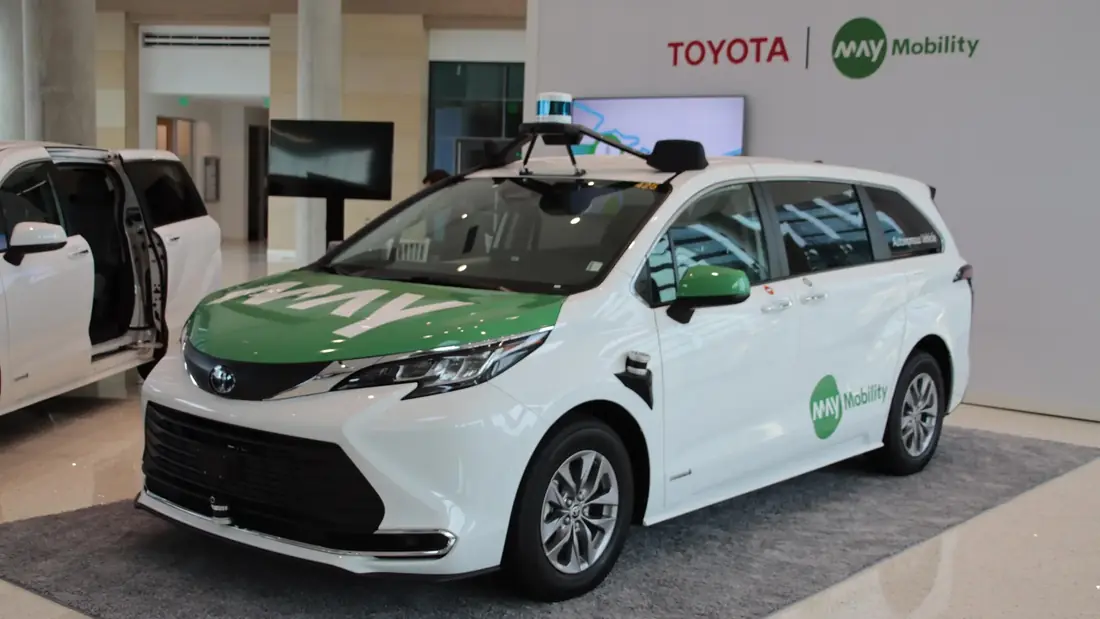
On 16 September 2026 May Mobility announced it would go public by merging with a listed shell company, ACP Holdings Acquisition Corp., at an enterprise value of about $1.4bn. The combined company would trade on Nasdaq as MAY. The headline number in the announcement was 550,000 commercial autonomous rides across 1.1 million miles. That is a real record, built up since 2018. It also needs reading carefully, because most of those rides had a person in the driver's seat.
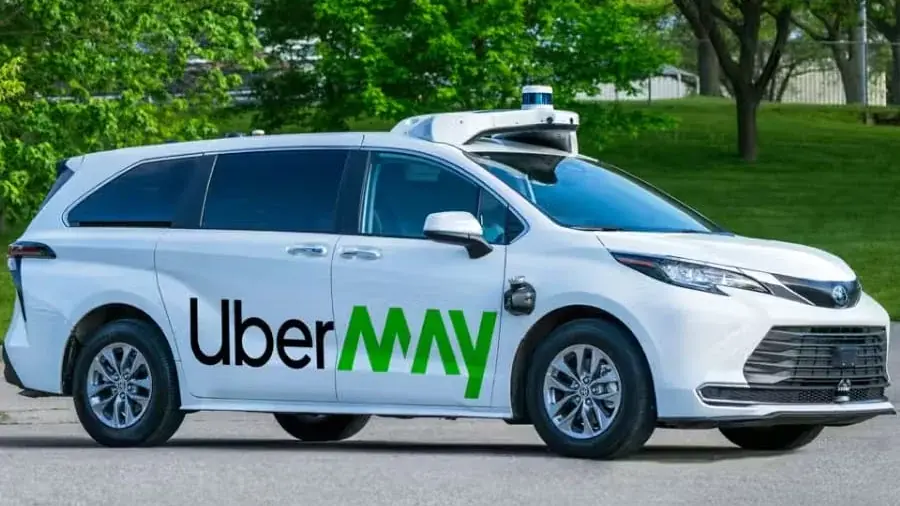
May is one of the less famous American autonomous-ride companies, and one of the more unusual. It does not build cars, and it does not run a robotaxi brand of its own. It fits Toyota Sienna minivans with its driving system and supplies them, through partners, to Lyft, Uber and city transit agencies. It calls this “autonomy as a service”.
Driver-out deployments in May Mobility's history, all in the US: Sun City, Arizona; Ann Arbor, Michigan; and Peachtree Corners, Georgia. It is aiming for a fourth in late 2026 or early 2027.
What it is
May was founded in Ann Arbor, Michigan, in 2017. Its chief executive, Edwin Olson, was a robotics professor at the University of Michigan. It had about 280 employees at the end of November 2025 and has raised about $445m. Its investors include Toyota's venture arm and Japan's NTT, which led its two most recent funding rounds.
Toyota is what May calls its “primary OEM partner”. It supplies the Sienna Autono-MaaS, a version of its hybrid minivan built to be driven by a computer. May's sensors and software are then fitted by outside companies. In Japan, May also runs Toyota's boxy electric e-Palette shuttle.
The business model is asset-light. Partners own the vehicles, the depots and the maintenance. May earns licence or per-trip fees and keeps the software and the remote assistance. In 2025 that brought in about $10m of revenue, at a 27 per cent gross margin, against a cash burn of about $93m.
Where it drives
May's merger announcement lists three current US commercial operations:
- Atlanta, with Lyft. Paid rides in the Lyft app since September 2025, in Midtown and neighbouring districts, with a safety operator in the driver's seat.
- Eden Prairie, Minnesota. A microtransit service for the local transit agency, with wheelchair-accessible Siennas and an operator aboard.
- Grand Rapids, Minnesota. A free rural service called goMARTI. Minnesota law requires a licensed driver aboard; the vehicles drive themselves most of the time.
None of those is driverless. May's driver-out experience comes from three smaller places. Sun City, Arizona (from December 2023) offered free rides to an invited group in a retirement community, and has since ended. Ann Arbor (from November 2024) covered a zone of about two square miles. Peachtree Corners, Georgia (from February 2025) is a fixed route of a few miles on weekdays.
Next are Arlington, Texas, with Uber, announced in May 2025 for the end of that year and now targeted for late 2026 or early 2027, and a pilot in Nagoya, Japan, with NTT since September 2026. May's own plan is for about 100 vehicles by the end of 2026 and 300–400 by the end of 2027.
May built up its 550,000 rides over eight years. Waymo was giving about that many paid rides every week by March 2026.
How it drives
This is where May is most interesting. Most of the industry is moving towards a single learned “end-to-end” model, as at Wayve, Tesla and now Rivian. May has built its system around what it calls multi-policy decision making.
Instead of one model deciding what to do, the car runs many short simulations of what might happen next and picks the safest plan. In its latest version, launched in May 2026, May says it runs “hundreds” of these what-if scenarios every 200 milliseconds, each looking up to 10 seconds ahead. Learned and rule-based options compete, and any that break its safety limits are thrown out. May's argument is that every decision can be traced and audited, which a single end-to-end model makes hard.
The hardware is deliberately ordinary. May's investor presentation lists a primary lidar with secondary lidars around the vehicle, cameras, radars and a dedicated traffic-light camera, and says it uses “no custom sensors & no custom silicon”. It does not name its suppliers. Remote “assist agents” support the vehicles from a distance.
The listing
The deal values May at about $1.4bn, which is about 140 times its 2025 revenue. The investor presentation gives the figure as $1,482m. It could bring in up to $337m: up to $217m from the shell company's trust, if its shareholders do not take their money back, and a committed $120m private investment. That private money comes as convertible preferred shares carrying a dividend of up to 12 per cent a year, which is expensive money.
Three details in the filings are worth knowing:
- The going-concern warning. The presentation's risk factors say May's losses and negative cash flow “raise substantial doubt about our ability to continue as a going concern”. That is standard language for a loss-making company raising money, and it explains why this money matters.
- The timing. The press release says the deal should close “by year-end”; the presentation says the first quarter of 2027.
- The “first”. May calls itself “the first U.S. publicly listed pure-play autonomous ride-hail technology company”. The “U.S.” is doing the work: China's Pony.ai and WeRide have been on Nasdaq since 2024.
What we cannot tell you
- How safe it is. May publishes no safety data, and its investor presentation contains none. We found no recall or federal investigation of May's driving system in 2025–26, but that is not the same as evidence of safety.
- How many of the 550,000 rides were driverless. May does not split the figure. Many were free transit or pilot rides, so they should not be read as paid robotaxi trips.
- Whether Ann Arbor and Peachtree Corners are still running driver-out today. The presentation lists them as May's driver-out deployments; the press release's list of current operations does not include them.
- Who makes its lidar and computers. May has not said.
Fact sheet — May Mobility (2026)
The ai.cars verdict
- May has a longer operating record than most of its rivals, across transit agencies, retirement communities and ride-hail, in the US and Japan.
- Most of that record was made with a human aboard. It has run driver-out at three small sites, and its Lyft and Minnesota services still carry operators.
- Its approach, many simulated futures and the safest plan, is a genuine alternative to end-to-end AI, and easier to audit. May has not published the safety data that would show whether it works better.
- The business is small: about $10m of revenue against about $93m burned in 2025, with a going-concern warning in its own filings.
- The listing buys it time and money to take the drivers out of Atlanta and Arlington. That is the test, and it has not happened yet.
- Verdict: a credible, cautious operator with an interesting brain and a long road to scale. Judge it on the fourth driver-out deployment, not on the 550,000.
How does it stack up? Set it against Zoox, or against Wayve and Uber in London.


