Xiaomi YU7: every sensor, and permission for almost none of it
A 128-line lidar, 4D radar and 700 TOPS of Nvidia Thor come standard on the cheapest YU7 — a $32,700 electric SUV. China's first Level 3 approvals went to two cars with a fraction of that hardware. The bottleneck in Chinese autonomy has stopped being silicon.

Xiaomi's own launch material puts it in one sentence: “the entire Xiaomi YU7 series is equipped with a Thor™ chip, 1 LiDAR, 1 4D millimeter-wave radar, 11 high-definition cameras, and 12 ultrasonic radars.” The lidar sees 200 metres. The compute is an Nvidia DRIVE AGX Thor at 700 TOPS on Blackwell. In May 2026 Xiaomi added a cheaper YU7 at ¥233,500 — about $32,700, roughly ¥20,000 below the previous entry car, on a smaller 73 kWh battery. The price came down. The sensor set did not.
We have written that sentence about Chinese cars before, and it is becoming the defining fact of the market. What makes the YU7 worth its own review is the other half, which has moved: China started approving Level 3 in December 2025, and Xiaomi was not on the list.
Cars approved for Level 3 in China as of December 2025 — a BAIC Arcfox and a Changan Deepal. Neither carries the YU7's hardware. Xiaomi is not among them.
What the YU7 actually is
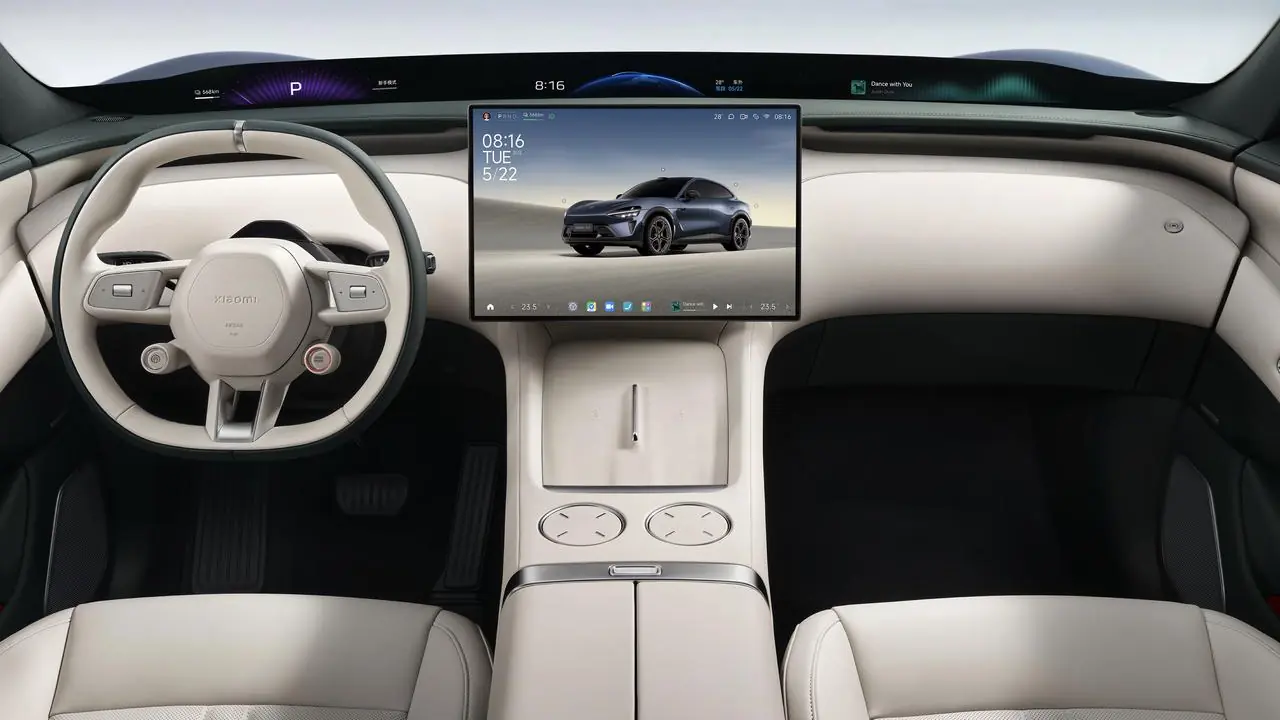
It is a five-metre electric SUV on a three-metre wheelbase, which in the segment it competes in makes it enormous inside. Xiaomi launched it in three versions and its own figures are worth stating in its own order: Standard, rear-drive, 96.3 kWh, 835 km CLTC — the longest-range version is the cheapest one; Pro, all-wheel drive, the same 96.3 kWh pack, 760 km; and Max, all-wheel drive, 101.7 kWh, 770 km, 690 PS and 508 kW, 3.23 seconds to 100 km/h and 253 km/h. In May 2026 Xiaomi added a cheaper entry car at ¥233,500 with a 73 kWh pack and 643 km, and a GT at ¥389,900 — 1,003 PS, 2.92 seconds, 300 km/h and a 7:22.755 lap of the Nürburgring.
A note on the ladder, because the reporting is muddled and we would rather say so than tidy it up: the 2026 entry car has been described as the “YU7 Standard”, which is also the name of the 96.3 kWh launch car. We have kept Xiaomi's original naming for the launch trims and described the 2026 additions by their prices and batteries.
Charging is a whole-range claim rather than a top-trim one. Xiaomi puts the entire series on an 800-volt silicon-carbide platform peaking at 897 volts, with a maximum rate of 5.2 C, 10 to 80 per cent in 12 minutes and 620 km added in fifteen. On the cheaper 73 kWh car the quoted figure is 385 km in fifteen minutes, which is the number that actually matters to someone who drives it.
It sold 152,344 units in 2025 from a June launch, and Xiaomi has now delivered more than 700,000 cars since it started building them in March 2024, against a 2026 target of 550,000. Whatever else is true, this is not a curiosity. It is one of the highest-volume electric SUVs in the world.
Hardware has stopped being the constraint
On 16 December 2025, MIIT granted China's first national product approvals for Level 3 driving to two cars: BAIC's Arcfox Alpha S and Changan's Deepal SL03. These are not test permits. They allow hands-off, eyes-off operation — the Deepal in Chongqing, in congested urban and expressway traffic, single-lane, up to 50 km/h; the Arcfox in Beijing, single-lane on expressways and urban motorways up to 80 km/h. Every new city needs its own local approval on top.
Read those conditions and the point becomes obvious. Single lane. Fifty kilometres an hour. One city. These are not the specifications of a car that has out-engineered the YU7; they are the specifications of a legal document. What BAIC and Changan have that Xiaomi does not is paperwork.
The YU7, with more sensing than either, is certified for hands-on Level 2. The system is called Xiaomi HAD — Hyper Assisted Driving — and the name itself is a regulatory artefact, which brings us to the uncomfortable part.
"Single lane, fifty kilometres an hour, one city. Those are not the specifications of a better car. They are the specifications of a legal document."
Why Xiaomi, of all companies, says so little
In April 2025, MIIT banned carmakers from using “autonomous driving” or “automatic driving” in marketing, required systems to be described by their actual SAE level, prohibited advertising features as “beta”, restricted over-the-air updates so that emergency ones follow recall procedures, and banned driverless parking and retrieval. Level 2 hands-off remained unapproved for consumers.
That crackdown followed a fatal crash involving a Xiaomi SU7. We covered it, and what it cost, in our SU7 review; we are not going to relitigate it here. The relevant point for the YU7 is narrower and stranger: the company that triggered the rules now sells the most heavily sensored mainstream car in China and is among the most constrained in what it may say about it. “Hyper Assisted Driving” is what a marketing department produces when it may not use the word it wants.
More is coming. MIIT has drafted mandatory safety requirements for Level 3 and Level 4, targeted at 1 July 2027, that would replace the 2024 voluntary guidelines. Automated systems would have to “at least match the safety level of a qualified and attentive human driver”. Level 3 cars would need biometric monitoring of whether the driver can actually take over, documented driver training before first use, a Minimal Risk Manoeuvre when the driver does not respond, and a DSSAD black box recording incident data for liability. That is a serious regime, and it is the real reason a 700-TOPS SUV drives hands-on.
The other thing Xiaomi is selling
Buried at the end of the launch material, under the heading “respect for speed, safe driving”, is something no other carmaker on this site announces alongside a product: paid driver training. Xiaomi's advanced course — straight-line acceleration and braking with emergency lane changes, slalom drills, cornering technique, wet-surface handling — is listed at RMB 1,999, about $280.
Read it uncharitably and it is merchandising. Read it in context and it is a company that has been publicly associated with a fatal crash deciding that the driver is part of the safety system and can be improved, at a price. Either reading is more interesting than the silence everyone else offers. It sits oddly, and revealingly, next to 700 TOPS of compute: the most heavily sensored car in its class, sold with lessons.
Germany, 2027, and the question that matters
On 3 September 2026, Xiaomi confirmed it will launch in Germany in 2027, signing memoranda with eight dealer groups — Ernst Dello, Dinnebier, Emil Frey, Fett & Wirtz, Hahn, LUEG, Penske-Jacobs and SPT Avior. Franchised dealers rather than direct sales, which is a more conventional choice than most Chinese entrants have made.
Here is the question this site will be asking when those cars arrive. Every Chinese car we have reviewed that crossed a border left its best driving software at home: the Atto 2, the Atto 3, the Sealion 7, the Denza D9. In each case the explanation was some mixture of type approval, mapping and liability.
Xiaomi arrives into a Europe that has since built the legal route. UN Regulation No. 171 — the DCAS framework the BMW iX3 is certified under — makes hands-off driving legal in Europe without the manufacturer taking on Level 3 liability. It exists, it works, and a Chinese group has already used it: Geely's G-ASD was certified under R171 on 18 March 2026. Corrected 22 September 2026: this review originally said no Chinese manufacturer had used it. Xiaomi will land in Germany with the hardware already fitted and a regulation already written. If HAD still does not cross the border, the reason will not be that Europe had no mechanism.
What we're watching
- Whether Xiaomi appears on a Chinese Level 3 approval list, and how far behind BAIC and Changan it ends up. It has the hardware; this is purely a certification race now.
- Whether the July 2027 mandatory standard lands on time, and what a DSSAD black box does to how these crashes get argued about.
- Whether HAD reaches Germany in 2027 in any form, and whether Xiaomi certifies anything under UN R171. Geely got there first, in March 2026 — so the route is proven and the question is only whether Xiaomi pays for it.
- Whether the next price cut touches the sensors. It did not this time — ¥20,000 came off the entry car and the lidar stayed — and that is the tell for whether the hardware is strategy or marketing.
- Whether 550,000 deliveries in 2026 is reachable. It needs roughly double the monthly pace Xiaomi was running in the spring.
Spec sheet — Xiaomi YU7 (2026, China)
The ai.cars verdict
- Xiaomi's own words: every YU7 carries “1 LiDAR, 1 4D millimeter-wave radar, 11 high-definition cameras, and 12 ultrasonic radars” on a 700 TOPS Thor. From about $32,700, that is the most sensing per dollar of any car on this site.
- The May 2026 price cut took ¥20,000 off the entry car and left the sensor suite alone. When a maker cuts price without cutting sensors, the hardware is strategy rather than decoration.
- It is certified for hands-on Level 2. China's first Level 3 approvals, in December 2025, went to a BAIC Arcfox and a Changan Deepal — single-lane, 50 to 80 km/h, one city each, and far less hardware.
- The constraint in Chinese autonomy is now certification, not silicon. That is a genuine inversion of where this industry was three years ago.
- Xiaomi is more constrained than most in what it may claim, for reasons documented in our SU7 review. “Hyper Assisted Driving” is the regulation showing up in the brochure.
- A mandatory national standard is drafted for 1 July 2027: biometric takeover monitoring, driver training, minimal risk manoeuvres and a DSSAD black box for liability.
- Xiaomi also sells its owners advanced driving lessons at RMB 1,999. No other maker here announces driver training alongside a car, and the reading of that — merchandising, or an admission that the driver is part of the system — is worth arguing about.
- Verdict: an outstanding car and a case study in the gap between what a vehicle can sense and what its owner is allowed to let it do. Germany in 2027, with UN R171 available and unused by any Chinese maker, is where that gap gets tested next.
How does it stack up? Compare the YU7 with the Zeekr 9X, or build your own comparison.


